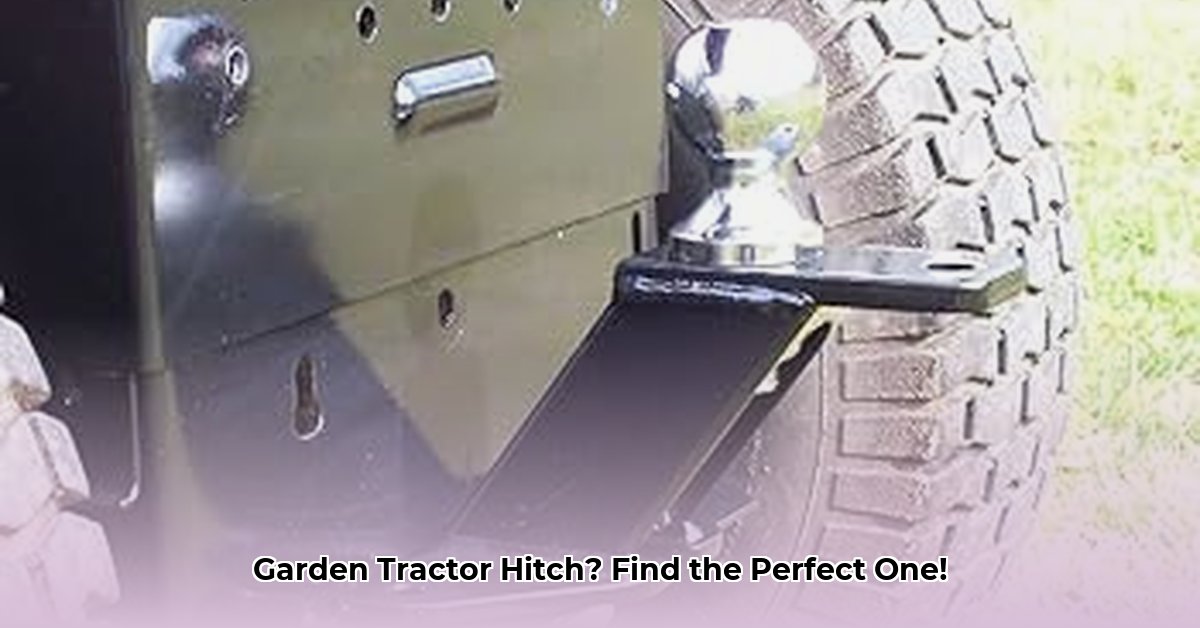
Knowing how to choose and use a hitch for your garden tractor can significantly increase its versatility and efficiency. This guide provides step-by-step instructions, safety guidelines, and troubleshooting tips to help you get the most out of your tractor. We'll cover everything from selecting the right hitch type to ensuring safe operation and maintenance. For more information on older John Deere models, check out this helpful resource: John Deere resources.
Understanding Your Hitch Options
Several types of hitches exist, each designed for different tasks and tractor capacities. Choosing the wrong hitch can damage your equipment or even cause injury.
- Category 0 Hitches: These are lightweight, suitable for smaller attachments like cultivators or small tillers. Think of them as the entry-level option.
- Category 1 Hitches: These are more robust and handle heavier-duty implements, such as larger tillers, box scrapers, and small trailers. These offer increased strength and capacity.
- Three-Point Hitches: Offering superior stability and lifting power, three-point hitches are best for heavier equipment and more demanding tasks. They provide a much more secure connection.
- Drawbar Hitches: These are specifically designed for towing trailers or other simple pulling tasks. They are the simplest type of hitch.
The appropriate choice depends entirely on your tractor's capabilities and the intended use. "Don't try to pull a heavy load with a lightweight hitch," advises Dr. Emily Carter, Agricultural Engineering Professor at Purdue University. "It's a safety hazard."
Matching Hitch and Tractor: Ensuring Compatibility
Compatible hitches are crucial for safety and equipment longevity. Incorrect use can damage your tractor and create dangerous situations.
- Consult Your Tractor's Manual: This is your primary resource for identifying compatible hitch types and weight limits. This information is essential and non-negotiable for safe operation.
- Measure Your Hitch Receiver: Carefully measure your tractor's hitch receiver (the part that accepts the hitch). Note the dimensions precisely, as even slight discrepancies can prevent proper fitting.
- Verify Manufacturer Specifications: Always confirm compatibility with the manufacturer's specifications, even if a retailer claims it’s a suitable fit. The manufacturer provides the most reliable data.
The table below offers general compatibility guidelines. Always consult your tractor's manual and the hitch manufacturer's instructions for precise details. This is merely a starting point, not an absolute guarantee.
| Tractor Brand | Common Hitch Types | Important Notes |
|---|---|---|
| John Deere | Category 0, Category 1, Three-Point | Model-specific compatibility is crucial; check your manual carefully. |
| Cub Cadet | Category 0, Category 1 | Always refer to your owner's manual for precise compatibility. |
| Simplicity | Category 0, Drawbar | Model variations are significant; thorough verification is needed. |
| Other Brands | Varies greatly | Extensive research is essential. Don't rely on assumptions. |
Remember: Never exceed the weight capacity of either your hitch or your tractor. Overloading is extremely dangerous and can lead to severe accidents.
Installing Your Hitch: A Step-by-Step Guide
The following steps describe a typical hitch installation. However, always consult your specific tractor and hitch manuals for detailed instructions. Deviations may occur based on equipment model.
- Preparation: Read all manuals carefully. Gather necessary tools. Park your tractor on a level, stable surface. Engage the parking brake firmly.
- Aligning the Hitch: Carefully align the hitch with your tractor's receiver, ensuring a snug fit. Improper alignment can lead to instability.
- Securing the Hitch: Use the provided bolts and fasteners to firmly attach the hitch. Tighten all connections completely. Recheck all fasteners to ensure they remain secure.
- Final Inspection: Conduct a thorough visual inspection of the hitch connection before operating the tractor. Ensure all parts are securely attached and show no signs of damage.
If anything feels loose or uncertain, stop and consult the manuals or seek professional assistance.
Safe Hitch Usage and Maintenance
Safe operation extends beyond correct installation. Regular maintenance and responsible use are vital for preventing accidents and maintaining equipment longevity.
- Weight Limits Are Not Suggestions: Always maintain a safe margin below the listed maximum weight capacity of both your hitch and your tractor. Overloading is dangerous and can cause equipment failure.
- Observe Safe Towing Practices: Tow at reduced speeds, particularly while making turns. Sudden braking or acceleration can lead to instability.
- Make Gentle Turns: Avoid sharp or abrupt turns, as these can put undue stress on the hitch and potentially cause accidents.
- Perform Regular Inspections: Routinely inspect your hitch for wear, damage, or loose fasteners. Address any issues immediately.
- Lubricate Moving Parts: Regularly lubricate moving parts to prevent rust and ensure smooth operation. This simple action contributes significantly to hitch longevity.
Ignoring these practices can result in equipment damage, injury, or even accidents. Your safety should be the top priority.
Troubleshooting Common Hitch Issues
If you encounter problems, consult your hitch's manual or the manufacturer's website for troubleshooting guidance.
- Hitch Won't Connect: Double-check the alignment and ensure all parts are clean and free from debris.
- Attachments Wobble: Verify that the weight is evenly distributed and that all connecting points are securely fastened.
Conclusion
By carefully following these guidelines and prioritizing safety, you can unlock the increased versatility and efficiency of your garden tractor hitch. Remember to always consult your equipment manuals for model-specific instructions.
Resources
[Link to relevant manufacturer websites] (Place links here after content validation) [Link to helpful online forums] (Place links here after content validation)